
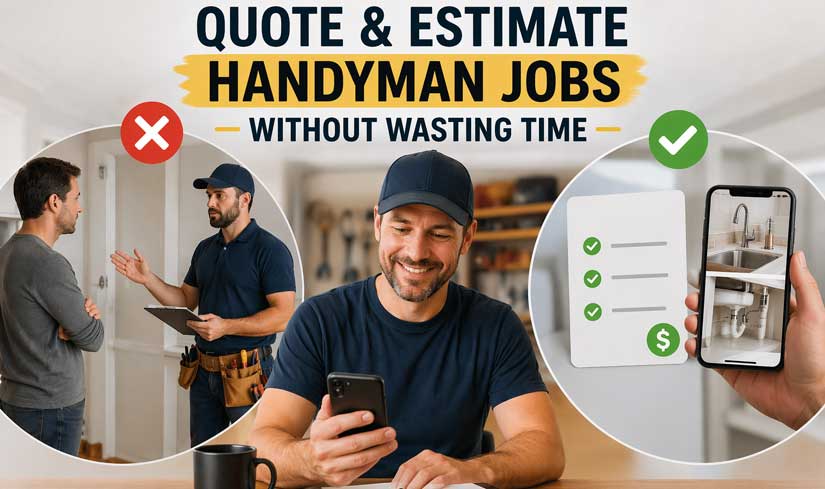
One of the biggest time-wasters for pro handymen is offering free estimates.
Many handymen spend 5-10 hours every week driving around quoting jobs. That’s an entire workday every week that you don’t get paid for, and many of those visits won’t turn into paying work.
The challenge, however, is that offering free estimates helps you land more jobs and charge higher rates.
So are free estimates worth it?
Well….sometimes.
Luckily, there are ways to provide free quotes and estimates without wasting 10 hours per week.
So in this article, I cover:

You can also listen to the podcast version of this article, which includes extra content!
HS055 – Should handymen give free estimates?
The allure of free estimates
Visiting a homeowner to provide a free quote for a small repair is a gigantic waste of time.
However, it does have some pretty compelling benefits.
The first benefit is increased conversions.
When you show up and meet a customer in person and present yourself as a professional, their trust in you goes way up, their perceived risk goes way down, and you are more likely to get hired – even if you charge higher rates.
For someone with an empty schedule, that’s pretty tempting.
The second benefit of an in-person quote is reduced pricing risk.
When you quote a job in person, you can quickly determine whether you can do the project, what it will require, and whether you even want the job before you commit. That way, you avoid getting into a sticky situation where you either can’t complete the repair or you underbid the project
These benefits, plus the fact that customers often expect you to “just come out and take a look,” are why so many handymen still drive around offering free quotes even though it is killing their productivity and profits.
But here’s why you shouldn’t give free estimates (in person).
To be clear, in-person quotes and sales processes are essential in many cases (more on that later).
However, for small repairs and projects, an in-person quote is rarely required. There are a couple of reasons for this.
First, many customers hire the first competent company that answers the phone. Homeowners just want their problem fixed with as little of their time and effort as possible, and as long as you answer the phone like a professional, have reasonable prices, and can handle the project within their desired timeline, you’ll usually get the job without having to visit them.
Secondly, a good online reputation will build enough trust for people to hire you without meeting you. Yes, meeting people face-to-face is the best way to build trust, but the slight bump in conversions isn’t worth the time trade-off. Another great reason to focus on getting more reviews.
Now let’s take a look at the numbers.
A customer visit for a quote will, on average, take about an hour and twenty minutes. That’s 40 minutes of driving (20 minutes each way), 20 minutes to build rapport and look at the project, and another 20 minutes to write up the estimate and present it to the customer.
Every hour you spend driving around giving free quotes is an hour you could have spent making money. Let’s say your rate is currently $125 per hour. Assuming you can keep your schedule full, that means one quote costs you $166 in lost income.
And even if your schedule isn’t completely full, you’d still be better off investing that time in upgrading your website or something else that actually moves your business forward.
If you are doing kitchen remodels, $166 of your time isn’t a big deal, but for small projects, it’s either killing your profits or requiring you to charge an extra $166 on each small job just to cover the costs.
So, free in-person quotes do very little for conversions for small jobs when you have a good reputation, but the downside is obvious.
FREE Handyman Startup Kit
Sign up for my email newsletter and get a FREE Handyman Startup Kit including: 
- Ten Profitable Handyman Services – Discover ten in-demand services that can earn you over $100 per hour with basic home repairs.
- Three Common Mistakes – Learn to avoid common pitfalls that can slow your progress and keep you from making money.
- 80/20 Handyman Marketing – Uncover the simple yet powerful marketing strategy that generates 100% of my new leads without spending a dime on advertising.
You’ll also receive exclusive content I only share with my email subscribers—all about growing a profitable and enjoyable business.
No BS. Unsubscribe at any time.
Here’s when a free in-person quote makes sense
- Big projects – Remodels, additions, and other large projects that easily exceed $1,000. Most homeowners wouldn’t even consider hiring a company for a kitchen remodel without meeting someone in person.
- Your first jobs – When you are just getting started and have little experience or credibility. However, you should move away from them ASAP.
- High-ticket upsells: When you have a proven process for turning a free quote for a small repair into a higher-ticket offering or a recurring service. For example, an HVAC company may happily provide free quotes because they know 85% of them will turn into repairs that at least cover the cost of the free quote, and 8% will turn into a full furnace and A/C replacement (~$20K+ job).
- Existing Clients – When you’re talking to a great client who hires you regularly for very profitable jobs, and you believe an in-person free quote is essential to keep their business. However, I’d still opt for other methods for booking the project if possible.
If a project doesn’t meet any of these criteria, a free quote or estimate probably isn’t worth it.
How to provide free estimates without wasting your time.
There isn’t just one simple way to fix this problem. You’ll need several tools to do it properly. Let’s start with the most important.
Strategy #1 – Qualify your leads
This is by far the most important step and is done on the first phone call. You can eliminate several time-wasting quotes per week by asking a few questions up front to every lead.
- Where are you located? If they aren’t in your service area, politely end the call.
- When were you hoping to get this done? If you can’t deliver in their timeframe, politely let them know, and they’ll either adjust or end the call.
- Do you own the home? If they are a renter, don’t waste your time. Let them know you’ll need to talk to the landlord. Politely end the call.
- Have you received other estimates? If so, why are you looking for more?
- Are you the decision-maker, or do you need to talk to someone else? If they need to talk to their spouse, try to schedule the visit when both are home. This question is only necessary for bigger projects where you plan to visit the home.
It may seem wrong to ask questions that could turn away customers, but it’s essential to save time and stay profitable.
If a lead isn’t going to be profitable, better to find out immediately, before wasting time.
Asking qualifying questions also signals that you are a pro and mean business. For many customers, doing so will gain you trust and respect.
Strategy #2 – Have flat rates for as many jobs as possible
Flat rates are particularly useful for projects you do regularly. Specializing helps you get more of the same jobs more consistently and is a great way to boost your profits.
The more repeatable your services become, the easier they are to price without visiting the home.
If a customer calls me about a project I specialize in, I can usually provide a price over the phone and close the job right there. That way, I don’t have to visit the customer to quote the job, and I can charge higher rates than I could if I charged by the hour.
If you have a receptionist answer the phones for you, this is a little more challenging, but it can still be done with good systems and training in place.
Strategy #3 – Have the customer text pictures to you
If I can’t provide a quote based on a verbal description, I’ll ask them to text me a few pictures. If they send me pictures and I need more, I’ll ask for more pictures from different angles. I’ll even ask for dimensions, depending on how I read the customer.
90% of the time, this gives me enough information to feel comfortable quoting the job without visiting the home, and customers are happy to do this. Many of them would prefer to send pictures rather than schedule time out of their busy weeks to meet me anyway.
After I get the pictures, I’ll take the time to write up an estimate and send it to them through the software that I use.
This isn’t as good as having flat rates because it takes an extra 10-15 minutes, but it’s still preferable to visiting the customer’s home.
Strategy #4 – Charge a diagnostic fee
Some jobs are impossible to quote via pictures, and you just have no idea what is wrong or if you can even fix it. Appliance repairs and electrical issues are two good examples where you need to troubleshoot to determine the root cause.
In these cases, a visit (and usually some work) is required to even identify the problem, let alone provide an estimate. These projects are the perfect time to charge a diagnostic fee.
Diagnostics fees have multiple benefits:
- You get paid for quoting a job. Usually not well, but at least it covers your costs.
- You quickly weed out most tire-kickers.
- When a customer agrees to the fee, they are making a small commitment toward hiring you and are more likely to have you complete the repair.
Worried this will scare away customers?
Don’t be. There’s a great article by Mike Persinger on Service Titan showing that charging a diagnostic fee (up to $89) will not hurt your booking rate. Even higher fees have been shown to have no effect on booking rates for solo business owners with a good reputation.
Typically, the best practice is to apply the diagnostic fee to the repair cost if the customer decides to hire you.
Applying this to your business
Here’s my current quoting/estimating workflow.
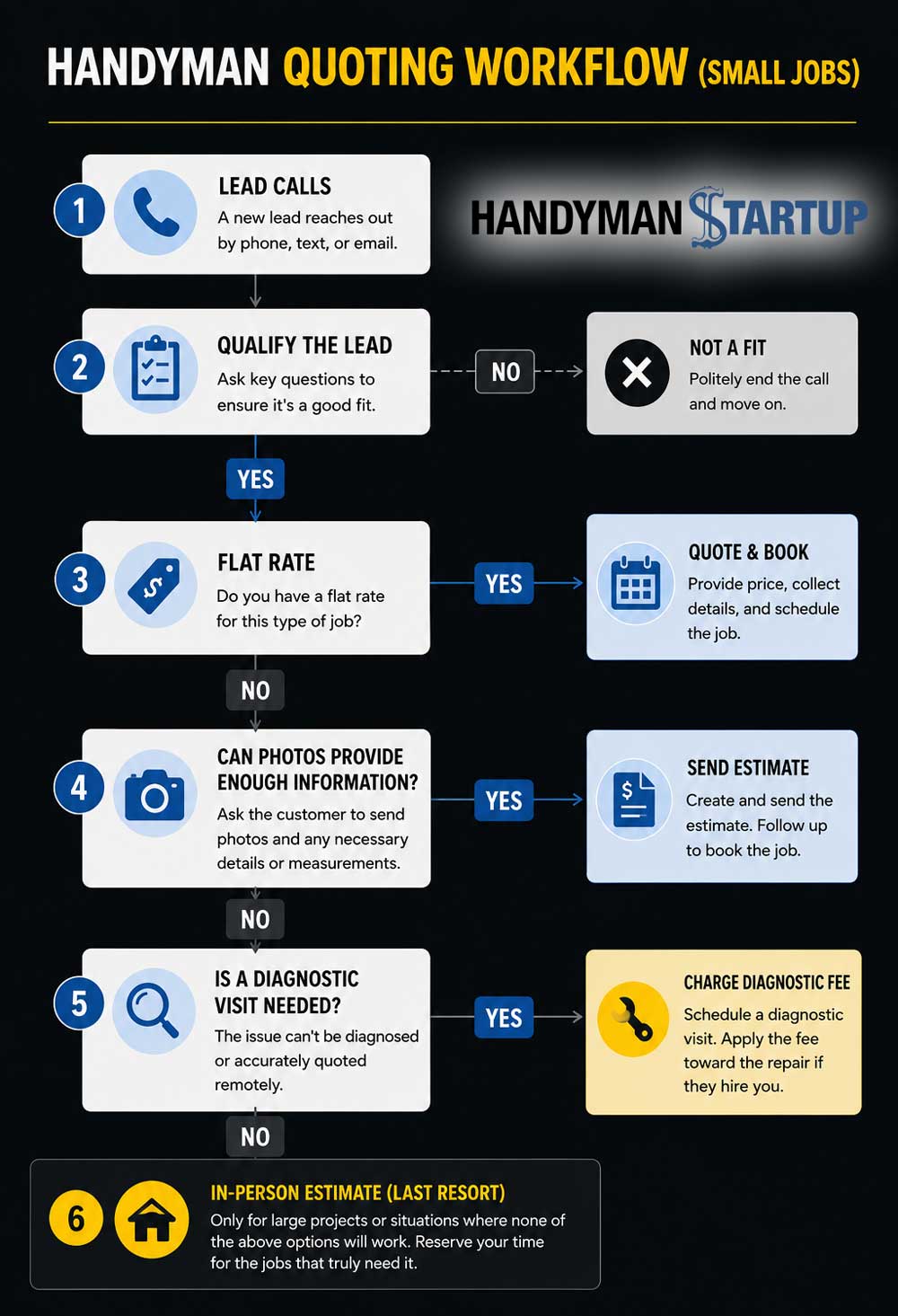
First, I qualify every lead before getting into the project details. My goal is to filter out as many dead-end projects and customers as quickly as possible. If you re-read the qualifying questions above, you’ll see that they are arranged so that the earlier the question is asked in the sequence, the more people will be disqualified.
Then, if I can quote the project based on my flat rates, I will explain my process and pricing, get all of the customer information, and schedule the job on the spot.
If I can’t use flat rates, I’ll get all of their information and then have them text me pictures. In rare cases, I have done video calls to get the required details. Many times, people will say things like “I think you should just come take a look.” But I do not relent. Instead, I assure them that I can get all the relevant information I need without a visit.
If it’s a project where pictures or additional details from the customer won’t help me, I’ll recommend a diagnostic visit as a last resort. But I’d still prefer to avoid this if possible, because diagnostic visits don’t pay as well as scheduled jobs do.
I like this process because it eliminates unnecessary scheduled visits while allowing me to maintain a relatively high hourly income (~$149 per hour for the first half of 2026).
Conclusion
Most handymen believe visiting customers to provide free quotes is simply part of the job. It isn’t.
The key is to create processes that allow you to estimate most small jobs remotely, reserve in-person visits for when they are essential, and get paid for troubleshooting.
Won’t customers expect a visit for a free quote?
Sure, some people will, but most won’t. And I’ve found that as long as I explain my process in a friendly and confident way, it builds trust and customers are more receptive.
How do you handle estimates in your business? Let me know by leaving a comment below.


Thanx
Very helpful Dan. Thanks for another great article and method.
Love the article.
The $166 per quote is the number that should stop people. We run a job board for traveling skilled trades workers, and the same math bites our guys on windshield time – the drive is the price whether anybody bills for it or not. The other half of pricing is knowing what the work is worth before you quote it, because rates move a lot from one market to the next and plenty of people are still quoting off what they charged two years ago. We pull what crews are actually being paid on live job postings so you can see where your number sits. Qualifying on the phone first is still the cheapest fix on your list.