
Specializing is one of the best strategic moves you can make as a pro handyman if your goal is to make more money in less time.
It makes almost everything about a home service business easier and more profitable.
I’ve covered the benefits of specializing in this article, so if the idea is new to you, I recommend reading it first.
The challenge, however, is choosing the right service.
So, in this article, I’m going to share 3 key criteria for choosing profitable services to specialize in:
Let’s look at each one.

Listen to the podcast version of this article, which includes extra content. Listen right here or on your favorite podcast app.
HS056 – Profitable services to specialize in – 3 key critera
Criteria #1 – Proven Demand
 This one may seem obvious, but people mess it up all the time.
If not enough local customers will pay for a service, don’t waste your time trying to specialize in it.
Ideally, pick a service people are actively searching for, as it’s much easier to fill your schedule that way.
Fortunately, you don’t have to guess whether there’s demand. You can get a pretty good idea by asking a few simple questions:
- Is there at least one profitable local company that already specializes in that service and has been in business for at least one year?
- Is there a category for this service when you sign up for a lead generation service like Angi or when you set up your Google Business Profile?
- Are several of your customers regularly asking you to perform this service?
If you answered no to all three, move on to your next idea. If no one else specializes in a service, there’s probably a reason.
New business owners often think they need a new idea to make a lot of money. They see competition as a bad sign.
That’s backward.
Competition is a good sign that there are people willing to pay enough for you to run a profitable business.
If there is no competition, the idea either doesn’t work or it’s new and untested. Either way, your odds of succeeding with that service are extremely low.
So choose a service with enough demand, even if it has more competitors than you’d like.
Criteria #2 – High Customer Lifetime Value (CLV)
 Demand is necessary, but it isn’t enough. Just because a service is in demand doesn’t mean it’s worth specializing in.
Here’s an example. For a long time, I focused on TV mounting. I’ve made a lot of money doing it, usually earning $200+ per hour. It’s in demand, and you can make a high hourly income from it.
The problem is that the average job size is small, and customers don’t need TVs mounted frequently enough.
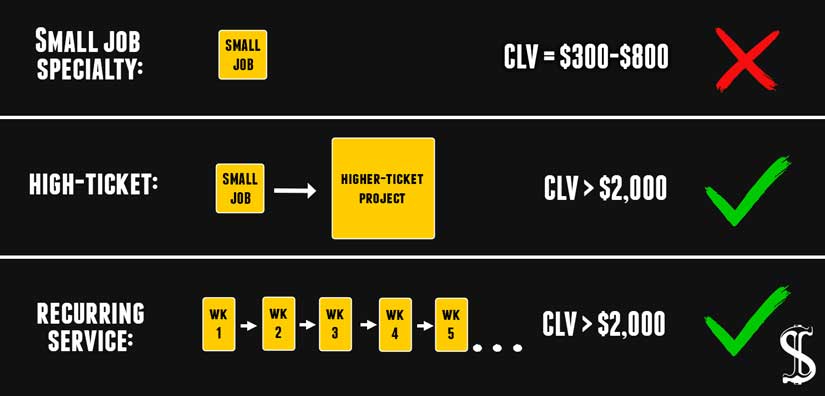
Most jobs end up being around $200–$500 for labor, and a rare, more complicated install might bring in $800.
That job size is perfect if you’re running a part-time business for some side money, but if you want to build a full-time business or hire employees, those small numbers will pose unnecessary challenges.
That’s because after marketing and admin costs, you’ll have razor-thin margins. Every job requires you to follow up with leads, answer customer questions, schedule the job, drive to the job, collect payment, and do the work. And that’s if everything goes to plan and the customer doesn’t cancel or need to reschedule.
This is where Customer Lifetime Value (CLV) is important.
CLV, sometimes called LTV, is the average total revenue your business will generate from a single customer over the lifetime of the relationship.
If you want to make a lot of money in less time, choose a service with a higher CLV.
Here are three basic ways to boost your customers’ average value.
- Sell a high-ticket service – Remodels and new construction are good examples. If you make $20,000 on a bathroom remodel, that easily covers the marketing, sales, and administrative costs of acquiring and serving that customer, with enough room for a few inefficiencies and a healthy profit.
- Sell a recurring service – Lawn care and pool maintenance are good examples. The average job size might be small, but you’re serving the same customers every week, and scheduling is consistent week to week. One small lawn care customer might be worth $2,000 every year. Many customers will be worth far more. The best part is that you don’t need to keep reselling new services constantly. Customers just keep paying for the same ones again and again.
- Sell multiple services to the same customer – This is what the traditional handyman model does well. You might mount a TV for someone today, fix a door and install some light fixtures next month, and then continue getting hired for years. Your average job size might be $500, but the CLV for a good customer may be $20K or more.
Suppose you specialize in fence and gate repair. Demand is high for this service, and you can charge a high hourly rate. That alone can boost your income.
But the real opportunity would be turning that small repair into a higher-ticket service. You could upsell pressure washing and staining. That could turn a $500 repair into a $2,500 full-fence makeover.
When a customer’s value goes from $500 to $2,500, it’s much easier to build a business around. You need fewer leads, fewer customers, less scheduling, and less driving from job to job.
Which brings me back to the TV mounting service. If I specialized instead in smart home installation and service, I could use TV mounting to get in the door and sell higher-ticket or recurring smart home services, significantly boosting my CLV.
So if you’re going to specialize and all else is equal, choose a service with a higher customer lifetime value. If the service you specialize in has a low CLV, find a way to increase it.
Critera #3: High Value-to-Complexity Ratio
 The third criterion is one that most people don’t think about, but it can make all the difference for your business.
I call it the value-to-complexity ratio (VTC).
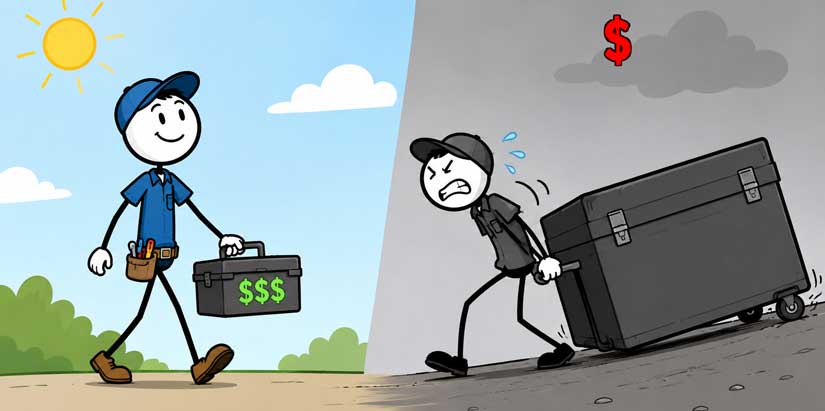
It sounds complicated, but it’s a pretty simple concept. The VTC ratio is how much you can charge relative to the cost of delivering the service.
The best services are relatively easy to provide and have high perceived value for your customers. The worst services are difficult to provide and have low perceived value.
Complexity can come in a variety of ways:
- The number of services you offer
- The difficulty of the work
- The number of tools required
- The time required to train new hires
- The sales process
- Scheduling
- Pricing
- The number of materials needed
- The skill/experience gap you must close before being able to offer the service.
You want your business to be as simple as possible while still being profitable. But that doesn’t mean you should automatically choose the easiest service.
You can’t avoid some complexity. If a service is too easy and highly profitable, competitors will quickly enter the space, drive prices down, and the service won’t remain profitable for long.
Instead, look for a service that is difficult in an area where you have strengths. That way, you have an advantage you can leverage.
HVAC, plumbing, and electrical services are good examples. These services require extensive specialized training and numerous tools, and they’re challenging to deliver. However, customers place a high value on these services. They know hiring a plumber or electrician can be expensive, and they hire them anyway.
Complexity is high, but so is value, so the VTC ratio is still favorable.
Custom cabinetry is another example. It’s relatively complex, but you can charge a premium.
Garage door companies hit the sweet spot. The services are relatively simple, but the perceived value is high. As a result, this space is increasingly competitive.
On the other hand, offering handyman services to low-income families can create the opposite situation. The complexity is high (lots of services, skills, tools, etc.), but it’s hard to charge enough to make that effort worthwhile. The VTC ratio here is unfavorable.
The VTC ratio doesn’t need to be perfect, but it’s a useful filter when deciding which services you’ll continue to provide, and to whom.
The better you are at keeping things simple while delivering a high value to customers, the more money you will make, and the easier your business will be to run.
FREE Handyman Startup Kit
Sign up for my email newsletter and get a FREE Handyman Startup Kit including: 
- Ten Profitable Handyman Services – Discover ten in-demand services that can earn you over $100 per hour with basic home repairs.
- Three Common Mistakes – Learn to avoid common pitfalls that can slow your progress and keep you from making money.
- 80/20 Handyman Marketing – Uncover the simple yet powerful marketing strategy that generates 100% of my new leads without spending a dime on advertising.
You’ll also receive exclusive content I only share with my email subscribers—all about growing a profitable and enjoyable business.
No BS. Unsubscribe at any time.
Putting It All Together
Specializing is a great way to make more money in less time, whether you are a single-person operation or you want to scale your business.
But to capture all the benefits, choose a service that meets all three criteria.
First, you need enough demand to keep you busy with that specialty alone. That lets you develop the skills, systems, pricing, and processes that boost efficiency and make specialization so powerful.
Second, each customer needs to be worth enough to make the business model work. If you can’t find a way to boost a customer’s lifetime value beyond a few hundred dollars, you’ll face constant headwinds to growth.
Finally, the service needs to have a favorable value-to-complexity ratio. You want to be able to charge enough to cover the costs of consistently delivering a high-quality service while allowing for some inefficiencies. If your business has to perform perfectly with razor-thin margins to survive, it probably won’t.
When you put these three things together, you have the foundation for a great business model. You’ll either make a healthy six-figure income with relative ease, or have a much smoother ride as you scale your business.


