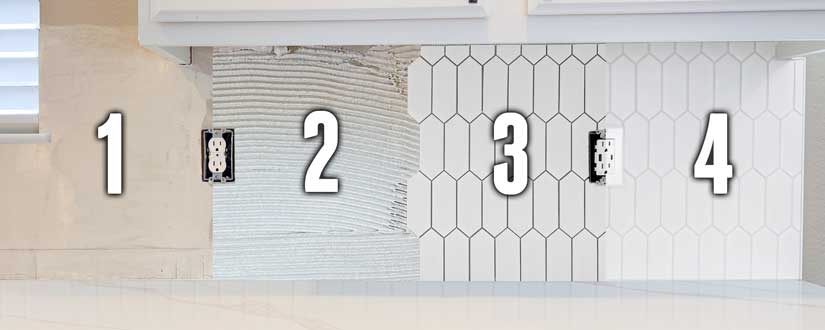
Installing a tile backsplash is easy if you follow the right process, even if you’ve never tiled before.
However, most tutorials only show half of what you need to know, leaving out necessary steps.
In this tutorial, I provide a comprehensive and easy-to-follow guide for installing a tile backsplash, so you can achieve professional results as a beginner.
Contents
- Video tutorial – How to install a tile backsplash (above)
- Tools and materials needed
- What size trowel do you need?
- Step-by-step written tutorial
- Cost breakdown vs. hiring a contractor
- How long does it take to install a tile backsplash?
Essential Equipment – Tools and Materials

Tools
- Wax pencil
- Trowel (See “What size trowel do you need?”)
- Putty knife
- Grout float
- 5 Gallon buckets X2
- Wet tile saw (you can rent one)
- Angle grinder w/ diamond blade
- Manual tile cutter (optional)
- Miter saw (needed for cutting edging)
- Metal blade (for cutting aluminum edging)
- Cordless Drill (for installing drywall)
- Level
- Laser level (optional)
- Mixer (for mixing thinset)
- Measure tape
- Razor knife
- Caulking gun
Safety Equipment
- Gloves
- Eye protection
- Ear protection
- Respirator
Materials
- Tile (10-15% extra)
- Tile Edging Trim (Optional – to end tile on open wall)
- Drywall, drywall screws, tape, and mudd (if replacing old drywall)
- Grout (I like Laticrete Permacolor)
- Thinset or Mastic
- Colored caulking to match grout
- Sponge
- Microfiber cloth (optional)
- Tile spacers
- Tile wedges
- Masking paper
- Masking tape
Tile used for this project:
Festival White Picket Matte Square Porcelain Mosaic (purchased from Floor and Decor)
What size trowel do you need?
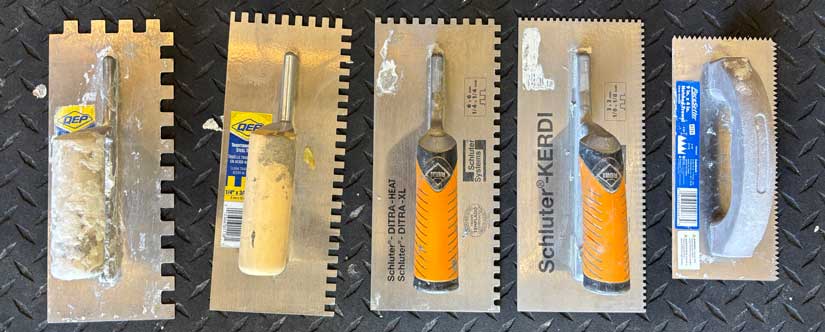
Choosing the right trowel size is essential. If you go too big, thinset will squeeze between the joints and make a mess. If you go too small, you won’t have enough thinset to adhere the tile properly.
For this project, I used a 3/16″ V-notch trowel since my tile was smaller
For small tiles up to 4″ x 4″, use a 3/16″ V-notch trowel.
For tiles up to 8″ x 8″, use a 1/4″ x 1/4″ U or square notch trowel.
Here are some rules of thumb when choosing the proper notch size for your trowel:
- Smaller tiles require a smaller notch size than larger tiles.
- Wall tiles require a smaller notch size than floor tiles.
- Irregularly shaped tiles require a deeper notch than smooth, consistent tiles.
Here’s a quick reference guide that I find helpful.
Installing a Tile Backsplash in 10 Easy Steps
Step 1: Measure and Shop for Materials

Start by measuring your backsplash area. You’ll need to know two things:
- Square footage – Measure the total area and plan to buy 10–15% extra tile to allow for cuts and mistakes.
- Edging requirements – Any place where tile ends on an open wall will need edging. You can use aluminum trim pieces (shown below) or tiles with a finished edge.
Once you have your measurements, print the materials list above, take it to the tile store, and select your tile. Keep in mind that your choice of tile affects difficulty. Smaller tiles, such as subway tile, are the easiest to install. Larger format tiles are slightly more challenging, and mosaic tiles are the most difficult.
Step 2: Prep the Walls
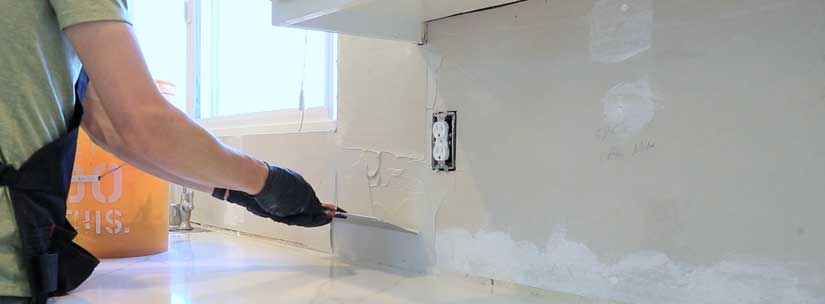
You want a flat, smooth, solid surface to mount the tile to. Drywall is ideal for a kitchen backsplash.
If your walls aren’t flat or smooth, then consider replacing the existing drywall or using drywall mud or thinset to level dips and bumps. If you are removing an existing tile backsplash, it’s much easier to remove the drywall along with the backsplash as I explain in the video above.
If you are installing new drywall, shim the studs behind the drywall so that they are all even with each other, creating as close to a perfectly flat wall as possible.
Pay special attention to the corners where two walls of tile will meet. Make sure both walls are plumb (perfectly vertical); otherwise, it will look terrible once you tile it.
If you are using mastic to attach the tile, you’ll also need to prime your walls. Any water-based primer is fine. If you are using thinset, you do NOT need to prime the walls.
Step 3: Plan Your Layout
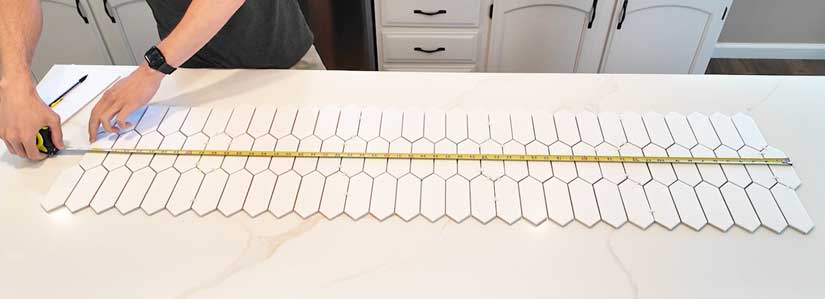
This is one of the most crucial (and challenging) aspects of the project. A good layout prevents awkward slivers of tile in visible areas.
This step requires patience, and here are some tips to help you achieve a solid layout.
- First, get an accurate measurement of the height and width of each tile (including grout thickness). You’ll get a much more precise measurement if you lay out several tiles with spacers in between and measure the total width. Then, divide the total width by the number of tiles you laid out.
- Next, choose a starting point (usually the most visible end) on each wall. This is where you will start laying the tile.
- Next, measure the horizontal distance from the starting point to each feature on the wall where you will need to cut tile to fit. Once you have those measurements, divide them by your tile width to determine if you will have any small slivers of tile around those features.
- If you notice an area where you will have small slivers, consider shifting the tile over by cutting the first tiles you start with. Ideally, you will avoid having slivers or awkward transitions.
- You’ll need to do the same vertically, and typically you’ll want to start with a partial tile on the bottom row. This allows you to contour the tile to the countertop while maintaining perfectly level grout lines.
- Check how level your countertops are and note where the high and low spots are if it’s not perfect.
Then, take some time to think things through. Pay special attention to the corners where two tiles meet, and ensure that you consider the thickness of your edging.
Sometimes slivers are unavoidable, and you’ll need to make tradeoffs. Just prioritize the most visible areas and do your best.
Step 4: Cut Your Edging
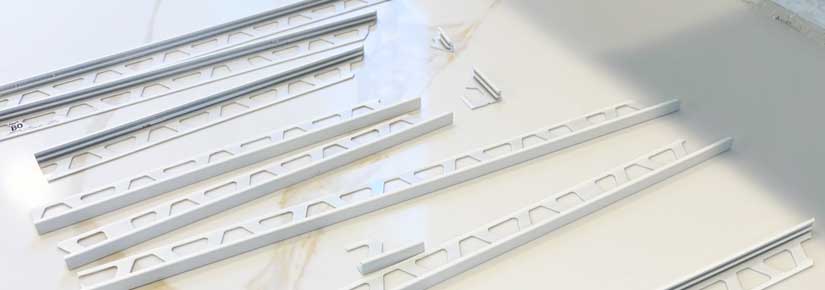
If your backsplash ends on an open wall, you’ll need edging.
The easiest type of edging is either an aluminum or plastic extrusion. These come in different widths, styles, colors, and finishes. Floor & Decor carries a wide variety of options that you can view in person.
Choose an edging that is just thicker than your tile, so that once you add the thinset or mastic, it brings the tile flush with the edging.
To cut the edging, carefully measure where it will go, then use a miter saw with a metal blade. If you don’t want to purchase a special blade, then consider using plastic edging instead.
The only way to get a clean corner with the aluminum edging is to use a miter saw. Any other method will either take way too long or look terrible.
If you don’t like the extrusions, you can also use quarter round or pencil tile as edging.
Step 5: Pre-Cut Your Tile (The Secret to a Better Install)
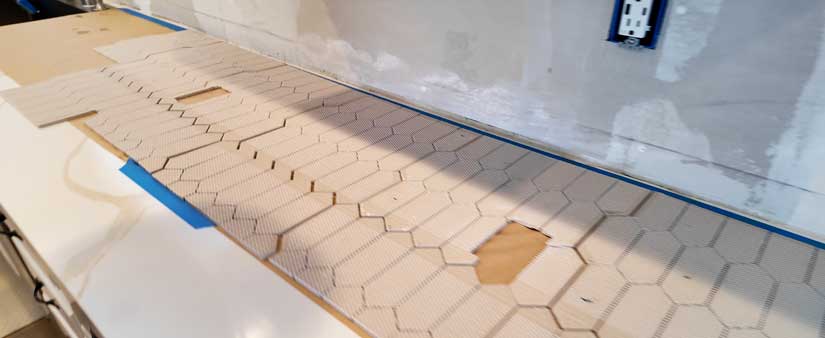
My #1 tip if you want to end up with a pro-looking install is to cut as many tiles in advance (before you start gluing) as you can.
Here’s why…If you follow what the pros do, you’ll be cutting and gluing tile at the same time. If you are highly skilled or have two people, this works just fine.
However, trying to do this by yourself as a beginner is a recipe for a stressful install and low-quality work. That’s because you’ll be working frantically against the clock: applying the glue, measuring for your cuts, running outside to make those cuts, setting the tile, inserting spacers, cleaning up as you go, and doing it all before the thinset hardens on your walls.
Not fun!
So instead, I recommend a different process that might be slower for a pro but faster and easier for you.
And that is to go one section at a time. Choose a section that is approximately 3-5 feet wide or less, and carefully measure and cut as many tiles as possible. Cut any other tiles that you can cut without risking mistakes as well.
You’ll likely still need to make cuts while gluing the tile to the wall, but they will be minimized.
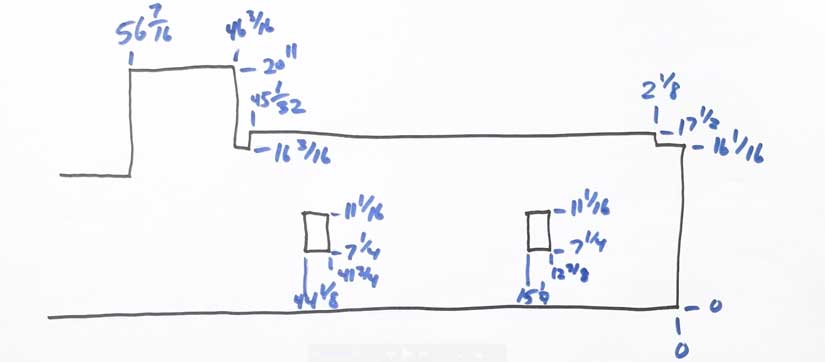
To achieve this, it’s helpful to create a diagram as I demonstrate in the video. Then use that diagram to lay out your tile, measure, and cut that entire section.
There are many ways to cut tile as I discuss here, but you’ll likely only need three tools:
- Wet tile saw: Cleanest cuts. Essential for slivers. Highly recommended.
- Manual tile cutter: Cheap and effective for quick, straight cuts with ceramic tile. Essential for glass tile.
- Angle grinder with diamond blade: Best for outlets or angled cuts, but dusty and more jagged cuts. I view this as essential.
For marking cuts, I recommend using a wax pencil (linked above) because it won’t wash off with a wet saw, but can be easily cleaned with a Magic Eraser.
Step 6: Prep the work area for Installation
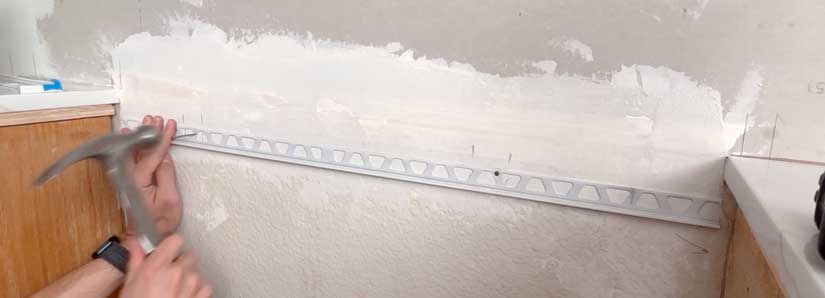
You’re almost ready to go, but there are a few things you’ll want to do before you apply the tile.
- Install a ledger board behind the stove – This will keep the tile from sliding down the wall before the thinset hardens. This can be a straight board that you remove later, or you can nail some extra edging to the wall if you have extra.
- Cover countertops with paper to protect from thinset and grout (tiling is messy)
- Shut off the breaker and move the outlets so you can install tile behind them.
Step 7: Apply the Tile Using Thinset or Mastic
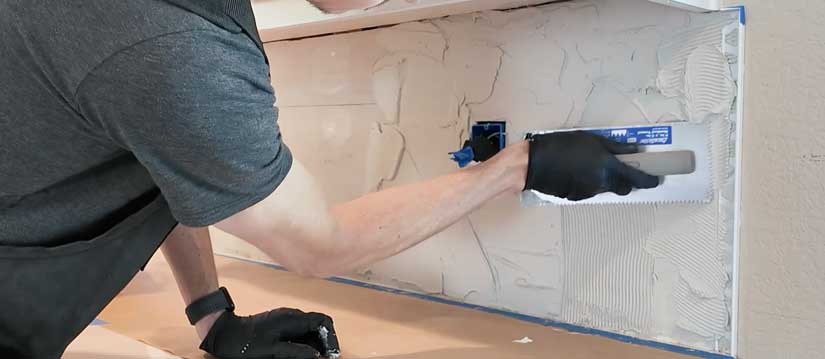
You can use Thinset or Mastic for applying backsplash tile. Here are the advantages and disadvantages of each.
- Thinset: Stronger and water-resistant. No primer is needed, but the product must be mixed before use. Here’s how to mix thinset.
- Mastic: Does NOT require mixing, which is a big bonus. However, it does require priming the walls first, which adds another step. It’s also not water resistant like thinset, but that’s not a problem for kitchens since you aren’ taking a shower in there (I hope).
You’ll use a trowel or putty knife to apply the thinset (or mastic) to the wall, then use a trowel with the appropriately sized notch to comb consistent lines in the thinset – no bare spots.
Only apply adhesive to a small section of the backsplash at a time, as you’ll only have about 20 minutes before it starts to harden, and applying the tile will take longer than you think.
Start applying the tile, working from one side of the wall to the other and working from the bottom tile to the top tile. Press each tile firmly into place with a slight wiggle. Use spacers to keep even gaps. For mosaics, press with a grout float to keep the surface flat. Don’t over-press, or thinset will ooze through the joints.
Clean up as you go with a sponge and a bucket of water. Maintaining a clean work area will make the job go faster and make subsequent steps easier.
Make sure to insert a 1/16″ spacer or tile wedge between the bottom tile and the countertop to maintain an expansion gap. Also, leave a small gap where two walls meet. These expansion gaps will be caulked later.
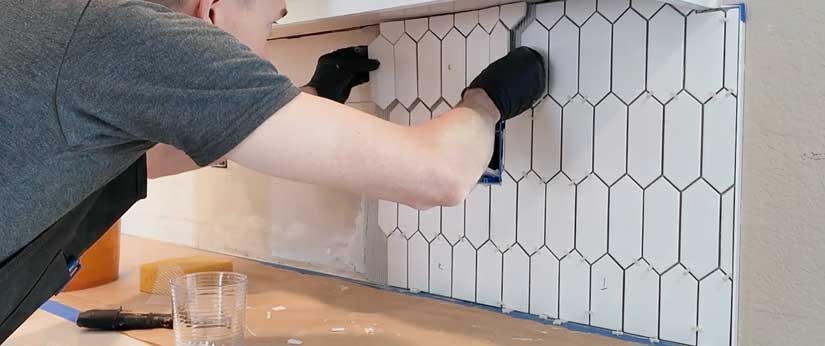
Wait for 30 minutes to a couple of hours and remove the spacers. They only need to be there long enough for the thinset to begin to harden, and should not be left in overnight.
When working with thinset, you’ll have approximately 1-2 hours after mixing each batch before it begins to harden if you keep it in the bucket and stir it occasionally. However, once it’s on the walls, you only have 20 minutes. This allows some time to make additional cuts.
Step 8: Grout the Tile
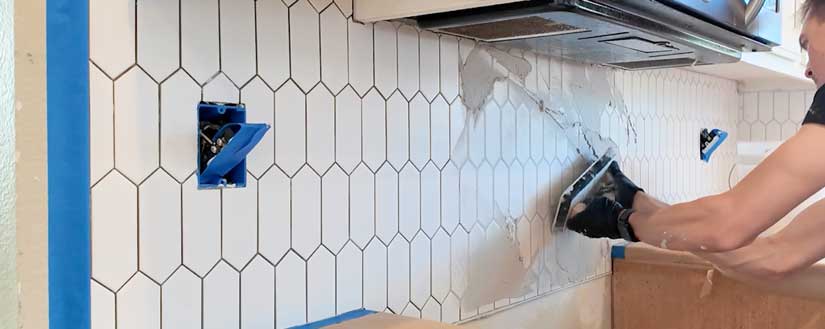
Let the thinset cure overnight. Then clean the tile and remove any adhesive that squeezed into the grout joints.
Then, mix a small batch of grout (about ¼ bag at a time) to a peanut-butter consistency. I recommend using a kitchen scale to accurately measure the mixing ratios.
Apply the grout with a float at a shallow angle and push it in from multiple directions. Once you have filled the joints completely, hold the float at a sharp angle and scrape the excess off of the surface of the tile before moving on to the next section.
Once you start applying the grout, set a timer for 25 minutes. After about 25 minutes, grab a sponge and a bucket of clean water. Wring the sponge out well and wipe in a circular motion to clean off excess grout and to form the grout joints.
Remove any grout between the countertop and the bottom later of tile and where two walls meet. You can use a putty knife or anything you fancy.
Your goal with the sponge isn’t to completely clean the tile, but to form the grout joints. You’ll notice a haze on the tile after you’ve used the sponge. That’s ok.
After a few hours, wipe the haze off with either a thoroughly wrung-out sponge or a microfiber cloth (or both).
Step 9: Caulk The Expansion Joints
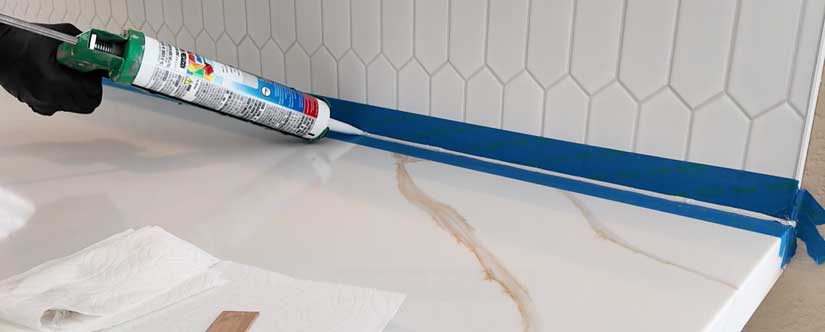
Once grout has hardened, caulk the joints along countertops and inside corners.
I highly recommend using a silicone caulking that matches the grout color you chose. Mapi and Laticrete both make high-quality silicone caulking that matches their grout colors.
To get perfect caulk lines without making a mess:
- Tape the countertop and tile on both sides of the joints you will caulk. Lay it carefully because it will form the shape of the visible caulk.
- Apply the caulking, ensuring the joint is completely filled with caulking.
- Wipe with your finger to push the caulking into the joint (wear some gloves).
- Then cut a shim with a squared edge to remove excess caulking as I demonstrate in the video.
- Finally, remove the tape immediately for crisp lines.
Step 10: Clean Up and Enjoy!
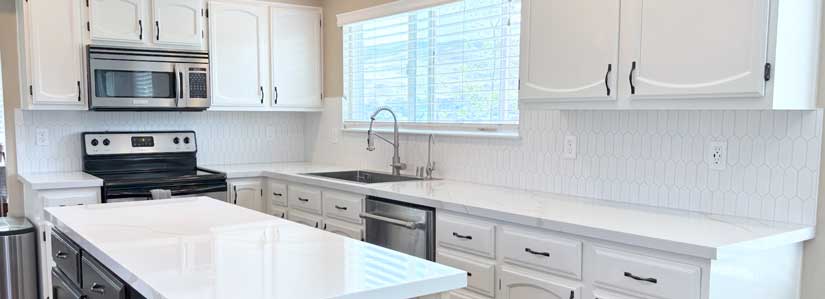
Once the caulk cures (12 hours or so), your backsplash is ready! Stand back and admire your work—you just transformed your kitchen!
Costs to install a tile backsplash:
The project shown in the video was completed in August of 2025, and the total cost was $353. However, I used a budget-friendly tile and had all the necessary tools except for a trowel. Here’s the breakdown:
- Tile: $212.67
- Tile edging: $51.98
- Drywall: $19.92
- Grout: $19.99
- Caulking: $15.99
- New Outlet: $14.99
- Trowel: $5.49
- Paper, tape, gloves: $9
- Wax pencil: $2.28
You will need to spend more if you don’t have all of the tools. Here are some additional costs you can expect:
- Wet Tile Saw: $350, or you can rent one for $100-$200.
- Angle Grinder: $75
- Cheap manual tile cutter: $25
- Thinset: $35
- Spacers, wedges, buckets, etc.: $25
Most DIYers can expect to spend between $400 and $600, depending on the number of tools needed and the type of tile chosen. The tile can vary significantly in price.
How long does it take to install a tile backsplash?
Pros can install a tile backsplash in 2-3 days. However, they are at least twice as fast as most DIYers.
So, expect to spend six full days to complete your project. That includes removing the old backsplash, installing drywall, laying the tile, grouting, and caulking.
Of course, your project will likely take longer than six days because you may not be working full-time. That’s OK. You can easily tackle this project in stages, with just a couple of hours here or there.
Turn your DIY skills into a profitable side business and make over $100 per hour.

Home repairs and improvements are in high demand, and there aren’t enough service pros to fill that demand.
This is a massive opportunity for any handy person who enjoys helping people.
If this sounds interesting to you, I recommend reading this free report.
You’ll learn ten profitable services you can offer TODAY without a contractor’s license.
Then, I’ll send you more information about what it takes to build a profitable and enjoyable handyman business.
FREE REPORT: 10 Profitable Handyman Services You Can Offer WITHOUT a Contractor License